Skip to content

How to Choose Laser Cleaning Equipment in 2026?

Choosing Laser Cleaning Equipment in 2026 is less about buying the highest-wattage machine and more about matching its process to your material, contamination, and production pace. A laser that lifts rust from a steel bracket may mark a delicate coating. Results depend on details: pulse duration, spot size, scan speed, and the operator’s settings. Small changes matter.

Laser-process specialist Alex Morgan, a composite expert voice for this guide, puts the principle simply: “Test the surface, not the brochure.” That means trialing the equipment on representative parts before committing. Watch the cleaned area under consistent lighting. Check edges, corners, and thin sections. Record the settings, too. A neat-looking surface is not proof that the substrate remains unaffected.

This outline explains how to compare pulsed and continuous-wave systems, assess power and control features, and plan realistic cleaning trials. It also covers extraction, operator training, maintenance, and the full cost of ownership. A lower purchase price can hide expensive downtime or replacement optics. And a machine with impressive specifications may still be a poor fit for your parts.

There is no universal winner. That can be inconvenient. The right choice depends on what you clean, how often you clean it, and what surface condition you need afterward. Use the guide as a decision framework, then validate its recommendations with a qualified supplier and a documented sample test.
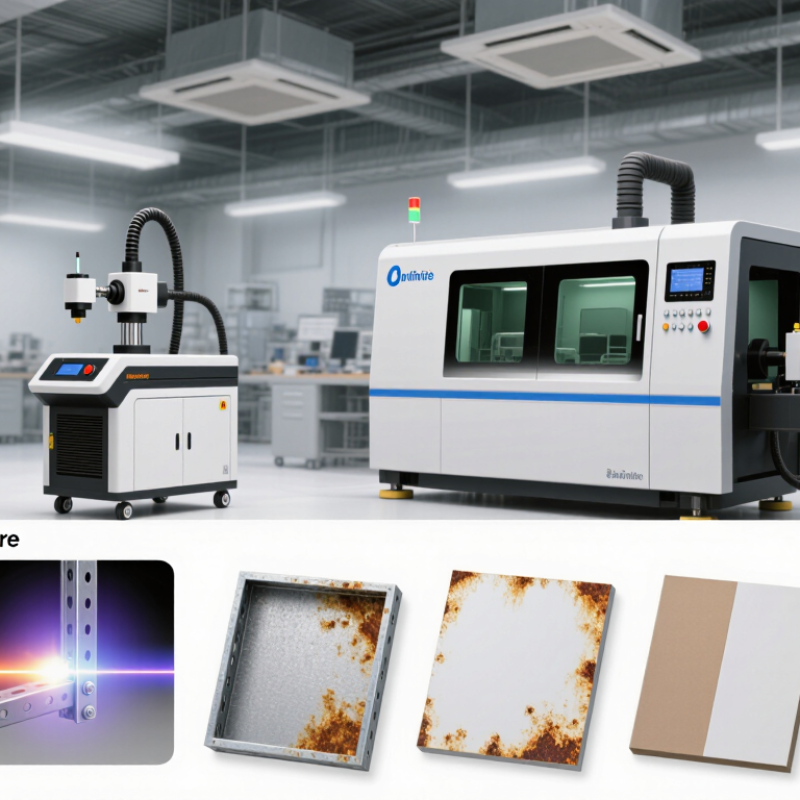
How to Choose Laser Cleaning Equipment in 2026?

Define the Cleaning Task and Surface Requirements

Before comparing laser cleaning equipment, define what must come off and what must remain. A thin oxide film on stainless steel calls for a different approach than oily residue on a molded part. Name the contaminant, estimate its thickness, and note whether it is bonded, flaky, or mixed with grease. Start with the residue.

Then describe the substrate and acceptable finish. Record the material, coating, surface texture, and any heat-sensitive areas, seals, or edges. A polished face may tolerate little change; a rough casting may hide residue in its pits. Set measurable acceptance criteria, such as a visual standard under fixed lighting, a permitted color shift, or a follow-up adhesion test. Measure twice.

Geometry matters too. Recesses, narrow grooves, and curved edges can receive uneven energy, so test representative areas rather than just a flat coupon. Use a controlled trial to check removal rate, substrate changes, dust behavior, and repeatability. Keep notes on settings and inspection conditions. It is tempting to call a surface clean when it looks clean. That judgment can be wrong. Invisible residue may still affect bonding or coating. Teams may not agree on “clean” until they inspect a sample. Resolve that before choosing power, pulse options, or automation.

Compare Laser Types for Different Contaminants and Materials

Choosing laser cleaning equipment in 2026 starts with the contaminant and the surface beneath it. Pulsed fiber lasers suit many rust, oxide, and paint-removal jobs on metal. Their short bursts can limit heat transfer, which matters on thin sheet or detailed parts. Keep substrate temperature in view. Continuous-wave lasers deliver sustained energy and can remove heavier coatings quickly. That speed can raise heat, discolor the metal, or alter a delicate finish.

The material changes the choice. Reflective metals, stainless steel, aluminum, and coated parts may respond differently, so match wavelength and pulse settings to the exact surface. For stone or concrete, excessive energy can roughen edges or leave visible marks. Paint thickness and pigment also affect removal rates. A clean-looking patch is not proof of an undamaged substrate. Before buying, test a representative sample with the same coating and surface condition. Compare removal speed, residue, heat marks, and surface texture. Record the settings, then inspect the result under good light. No single laser type fits every job; a small test can challenge an appealing specification.

How to Choose Laser Cleaning Equipment in 2026? – Compare Laser Types for Different Contaminants and Materials

Laser type Typical wavelength and operating mode Contaminants it may remove Material compatibility Best suited applications Key limitations and selection checks
Pulsed fiber laser Usually near-infrared, around 1064 nm; delivers short pulses rather than a continuous beam. Rust, oxide layers, paint, and other surface coatings, when the contaminant absorbs the laser energy more effectively than the substrate. Commonly used on steel, stainless steel, aluminum, and other metals. Suitability depends on the alloy, finish, coating, and process settings. Precision cleaning, localized treatment, restoration work, and applications where limiting heat transfer to the part is important. Removal speed depends on pulse energy, repetition rate, scanning, and contaminant thickness. Test on the actual part to check for discoloration, roughening, or substrate damage.
Continuous-wave (CW) fiber laser Usually near-infrared, around 1064 nm; emits a continuous beam while operating. Some rust, oxide, paint, and thicker or strongly bonded surface layers, depending on the process and workpiece. Primarily used for metal surfaces. The higher sustained heat input makes thermal effects on the substrate an important consideration. Higher-throughput cleaning of larger metal areas or robust parts where productivity is a priority. Can heat the workpiece more than a suitably configured pulsed process. Assess heat-sensitive parts, thin sections, coatings to be preserved, and fire risks before use.
CO₂ laser Infrared wavelength, commonly around 10.6 μm; available in continuous-wave and pulsed systems. Selected organic residues, paints, and coatings, depending on their absorption and the process setup. Often considered for certain nonmetallic materials and coatings. Bare metals generally reflect much of this wavelength, so direct metal cleaning may be less effective than with a suitable near-infrared source. Applications involving compatible organic layers or nonmetal surfaces where the material and residue respond appropriately to this wavelength. Do not assume it is compatible with every polymer, composite, or coating. Verify absorption, substrate heating, surface finish, and the laser’s wavelength-specific safety requirements.
UV pulsed laser Ultraviolet; 355 nm is a common wavelength in industrial systems. Typically operated in pulses. Fine surface films, selected residues, and delicate coatings where controlled, localized removal is needed. Can be considered for some metals, polymers, and other sensitive substrates, but compatibility is highly material- and formulation-dependent. Small or detailed areas, precision work, and processes where a smaller spot or limited thermal effect is desirable. UV exposure can damage materials and presents serious eye and skin hazards. Confirm the substrate’s UV response, process window, enclosure, and wavelength-rated protective measures.
Laser choice across common contaminants Choice depends on wavelength, pulse duration, pulse energy, average power, beam size, and scanning method. Rust and oxides: often evaluated with pulsed or CW fiber systems on metals.
Paint and coatings: wavelength and layer composition matter; pulsed fiber, CW fiber, or CO₂ may be considered.
Oil and grease: results vary with residue thickness and surface condition; pretreatment may be needed.
Match the process to the substrate—not just the contaminant. Consider base metal, alloy, polymer, composite, surface finish, and any layer that must remain intact. Use representative test coupons or a noncritical area to establish removal quality, speed, and repeatability before production. There is no universally best laser for a contaminant category. Confirm the required cleanliness level and inspect for substrate change, residual contamination, and redeposition.
Equipment and safety checks Review the complete system specification, including wavelength, operating mode, power range, scanning head, and duty cycle. Identify the contaminant and assess whether cleaning could release hazardous dust, fumes, or decomposition products. Check part geometry, reflectivity, thermal sensitivity, and whether the workpiece can be safely fixtured and cleaned. Compare extraction, enclosure, automation, maintenance, operator training, and throughput requirements alongside cleaning performance. Use a suitable enclosed or controlled work area, wavelength-rated laser protection, interlocks where applicable, and local exhaust ventilation based on a documented risk assessment.

Selection note: Cleaning performance depends on the specific contaminant, substrate, laser parameters, and process setup. Validate the proposed settings on representative materials and follow applicable laser-safety and ventilation requirements.

Match Power, Pulse Settings, and Delivery System to the Job

How to Choose Laser Cleaning Equipment in 2026?
Match Power, Pulse Settings, and Delivery System to the Job

Start with the surface, not the machine’s maximum wattage. A thick rust layer on a steel bracket may need higher average power than light oxidation near a delicate edge. But more power can also heat, discolor, or roughen the base material. Test on a representative offcut, then inspect under consistent lighting. Small details matter.

Pulse settings shape how energy reaches the surface. Short pulses can limit heat spread, while repetition rate and scan speed affect how quickly an area is treated. There is no universal “best” recipe. Grand View Research estimated the global laser-cleaning market at about US$0.7 billion in 2023; that figure signals adoption, not a recommended power level. Keep a written record of settings and results. It helps, though it will not capture every surface variation.

Match delivery to the work area. A handheld head suits large, accessible parts; a scanning head can cover broad surfaces evenly. Tight corners may require a smaller spot and careful operator control. Check cable reach, extraction needs, and line of sight before choosing. Under ISO 11553-1, laser processing equipment requires appropriate protective measures; include enclosure or controlled-area needs in the setup plan. A missed recess can leave residue. Test, inspect, and adjust.

Check Safety Features, Standards, and Operating Requirements

Choosing laser cleaning equipment in 2026 means checking safety features, relevant standards, and the real demands of your worksite. Confirm the laser’s classification and wavelength, then verify that guards, covers, and interlocks suit the intended setup. Ask for clear operating instructions and maintenance records. A warning label alone is not a safety system.

Tips: Check emergency stops, access controls, and protective eyewear requirements. Match eyewear to the specified wavelength and operating conditions. Small details matter. Keep the manual close to the equipment, not buried in an office file.

Review the standards and workplace rules that apply where the equipment will operate. Requirements can vary by location and application, so have a qualified safety professional assess the installation. Also check extraction needs, electrical supply, operator training, and space around the work area. A unit that fits the budget may still be a poor fit for a cramped workshop. Paperwork can look complete while practical gaps remain; a supervised test run can reveal awkward controls or blocked sightlines before routine use.

Evaluate Suppliers, Testing Options, and Total Ownership Costs

A laser cleaning quote should describe more than output power and purchase price. Ask the supplier to identify the source, scanning head, extraction needs, training, warranty, and expected service intervals. Request written answers, not only a sales presentation. Check who handles repairs and how quickly common parts can be supplied. A low initial price can become expensive downtime.

Testing is essential. Provide a representative sample with the actual coating, base material, and surface condition. Ask for a controlled trial and record cleaning speed, residue, heat effects, and surface appearance. Not every surface behaves alike. I once focused too heavily on advertised speed; the sample test revealed slower work around seams and edges. That changed the comparison.

Calculate total ownership costs over a realistic period, such as five years. Include electricity, extraction equipment, operator training, maintenance, replacement parts, safety measures, and production interruptions. Compare cost per cleaned area, not just cost per machine. Ask suppliers to state their assumptions, including shift length and material condition. Estimates still vary. Keep the trial results and cost assumptions together, so later changes in workload do not quietly distort the decision.