Skip to content

China Top 10 Commercial Trash Can Suppliers

China Top 10 Commercial Trash Can Suppliers introduces manufacturers serving offices, hotels, restaurants, hospitals, factories, and public facilities. This guide examines suppliers of Commercial Trash Cans through practical purchasing criteria, not promotional claims alone. Product details include stainless steel bodies, galvanized steel frames, plastic containers, pedal mechanisms, locking lids, wheels, and removable liners. A 120-liter bin may suit a compact restaurant area, while a 240-liter model can support larger collection points. Small details matter.

The evaluation considers manufacturing experience, material consistency, customization ability, quality control, export communication, and after-sales support. Buyers should request factory photos, production samples, test reports, packaging details, and references from comparable projects. Certifications must be checked against the destination market and the actual product model. A supplier may display an impressive catalog, yet its batch stability could remain unclear. That deserves attention. Pricing also requires careful comparison because thinner steel, weaker wheels, or poor welding can create higher replacement costs. Delivery schedules, spare parts, color matching, and logo printing should be confirmed in writing. The top ten list is therefore a practical starting point, not a permanent verdict. Supplier performance can change with management, materials, and order volume. Independent verification remains valuable, especially before a large purchase. This approach helps readers identify dependable manufacturers and select Commercial Trash Cans that fit real operating conditions, available space, cleaning routines, and long-term maintenance needs.
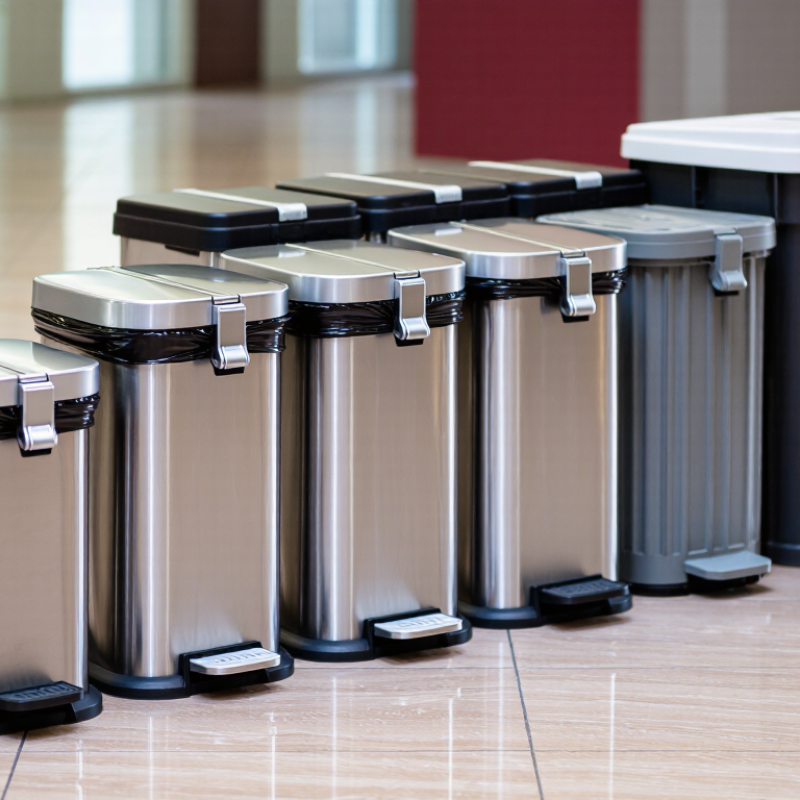
China Top 10 Commercial Trash Can Suppliers

China’s Commercial Trash Can Manufacturing Landscape

China’s commercial trash can manufacturing landscape is broad, practical, and highly segmented. Suppliers serve hotels, hospitals, offices, transport hubs, factories, and outdoor public areas. Stainless steel remains common where corrosion resistance and a clean appearance matter. Galvanized steel supports tougher outdoor use. Recycled plastic reduces weight, although color consistency can vary between production batches. Good factories usually control cutting, welding, polishing, molding, and final inspection in documented stages. This structure helps buyers compare the top ten suppliers beyond catalog images.

In supplier evaluation, production evidence matters more than polished sales language. Ask for material grades, load tests, fire-performance information where applicable, dimensional tolerances, and inspection records. A reliable manufacturer should explain liner capacity, lid movement, drainage design, and replacement-part availability. Samples should be tested in realistic locations, including wet loading bays and narrow corridors. Small details matter. A lid that closes loudly may disturb hotel guests. A thin pedal may fail under repeated use. Factory audits, video inspections, and traceable batch records add practical confidence.

China’s stronger manufacturers often provide custom designs, carton optimization, and mixed-container planning. However, customization can increase tooling costs, minimum order quantities, and lead times. Buyers sometimes overvalue low unit prices and overlook installation labor or damaged-goods rates. That is a costly habit. I would question every durability claim unless the test method is stated clearly. No supplier is perfect, and even a well-managed line can produce occasional defects. Clear acceptance standards, pre-shipment checks, and direct technical communication make the commercial relationship more dependable.

How the Top 10 Chinese Suppliers Are Evaluated

China Top 10 Commercial Trash Can Suppliers

The top ten suppliers are evaluated through evidence, not attractive catalogs. UNEP’s Global Waste Management Outlook 2024 estimates that municipal solid waste may rise from 2.3 billion tonnes in 2023 to 3.8 billion tonnes by 2050. This pressure makes durability, capacity, and serviceability practical requirements. Each supplier should provide material certificates, factory audit records, and recent production samples. Stainless steel thickness, weld quality, lid alignment, and wheel performance deserve physical inspection.

Price is only one part of the score. A useful evaluation measures total cost over five years, including liners, repairs, freight, and replacement parts. Suppliers should explain their monthly output, quality-control checkpoints, and inspection procedures. ISO 9001 certification supports process reliability, but it does not guarantee every batch is perfect. Independent testing should examine corrosion resistance, load strength, odor control, and fire-safety features where applicable. Small details matter. A loose pedal can damage user confidence quickly.

Experience also shapes the ranking. Suppliers serving hotels, hospitals, offices, and outdoor facilities should show anonymized project records and realistic delivery timelines. Export experience helps, but it should not replace technical proof. I would question unusually low quotations, especially when steel grades or coating thicknesses remain unclear. No scorecard is perfect. Human judgment can favor polished presentations over quiet manufacturing discipline. A stronger review combines factory visits, random sample testing, customer references, and documented corrective actions. That approach makes the final list more reliable and easier to defend.

Product Categories and Customization Options

Commercial trash can suppliers typically offer indoor, outdoor, recycling, food-waste, medical-waste, and smart collection categories. UNEP’s Global Waste Management Outlook 2024 estimates municipal solid waste could rise from 2.3 billion tonnes in 2023 to 3.8 billion tonnes by 2050. This pressure makes capacity and sorting design practical purchasing concerns.

Customization is not decoration. A supplier may adjust steel thickness, recycled plastic content, bin volume, lid style, caster size, and liner access. In a busy food court, narrow openings can reduce hand contact and limit oversized waste. Offices often need color-coded compartments, bilingual labels, and quiet soft-close lids. Outdoor models may require UV-resistant finishes, rain-shedding lids, anchoring plates, and anti-tamper hardware. Sensor-based fill monitoring is also available, although it adds maintenance and battery considerations.

Customization
Steel thickness, recycled plastic content, bin volume, lid style, caster size, and liner access.
Operational needs
Color-coded compartments, bilingual labels, quiet soft-close lids, and sensor-based monitoring.
Outdoor protection
UV-resistant finishes, rain-shedding lids, anchoring plates, and anti-tamper hardware.

Procurement teams should request drawings, material certificates, load tests, and cleaning instructions before approval. Field checks often reveal small failures, such as wheels that jam on uneven paving or labels that peel after repeated washing. A custom color can improve sorting, yet it may fade under strong sunlight. That weakness matters. Suppliers should also explain minimum order quantities, sample approval, replacement-part availability, and expected service life. According to the World Bank’s What a Waste 2.0 report, global waste generation was about 2.01 billion tonnes in 2016, highlighting why durable, clearly separated collection systems remain important.

Comparing Quality, Capacity, Certifications, and Pricing

China Top 10 Commercial Trash Can Suppliers: Comparing Quality, Capacity, Certifications, and Pricing

Commercial buyers should compare more than polished stainless steel. UNEP’s Global Waste Management Outlook 2024 estimates municipal solid waste will rise from 2.3 billion tonnes in 2023 to 3.8 billion tonnes by 2050. That pressure makes durability and capacity practical purchasing issues. For busy food courts, 120–240 litre bins with reinforced wheels often offer better workflow than smaller units. However, a large body can become difficult to move when fully loaded. Measure doorway width, lift height, and collection frequency before selecting from China’s leading suppliers.

Quality checks should include weld consistency, lid alignment, hinge strength, and corrosion resistance. Ask for material grades, load tests, and photographs from production batches. ISO 9001 can indicate a documented quality system, while ISO 14001 covers environmental management. Neither certification automatically proves a bin will survive daily abuse. Look for EN 840 compliance when wheeled containers are required for European projects, and verify the certificate’s scope and validity. This step is often skipped.

Pricing usually changes with steel thickness, plastic grade, volume, casters, printing, and custom tooling. A low quotation may exclude packaging, inspection, or replacement parts. Compare landed cost, not only factory price. Request three matched quotations using identical capacity and specifications. In practice, the cheapest option can develop noisy wheels or warped lids within months. That is not always predictable, and buyer assumptions deserve review. Reliability comes from samples, independent inspection, clear warranty terms, and traceable production records.

China Top 10 Commercial Trash Can Suppliers - Comparing Quality, Capacity, Certifications, and Pricing

Supplier Profile Main Product Range Typical Capacity Primary Materials Quality Rating Common Certifications or Standards Typical Price Range
(USD/Unit)
Typical MOQ Best Suited For
Supplier Profile 01 Heavy-duty wheeled waste containers 120–1,100 L HDPE, galvanized steel axles, rubber wheels ★★★★★ EN 840; ISO 9001 quality management commonly available $28–$165 50–100 units Municipal and industrial collection
Supplier Profile 02 Indoor stainless-steel bins and recycling stations 15–120 L 304 stainless steel, powder-coated steel, ABS ★★★★★ ISO 9001; RoHS documentation available for selected components $32–$210 30–80 units Hotels, offices, and shopping centers
Supplier Profile 03 Outdoor litter bins with weather-resistant coatings 50–240 L Galvanized steel, aluminum, treated wood composite ★★★★☆ ISO 9001; powder-coating and corrosion-resistance test reports $45–$280 20–60 units Parks, campuses, and public areas
Supplier Profile 04 Foot-pedal medical and sanitary waste bins 12–90 L Stainless steel, cold-rolled steel, fire-resistant plastic ★★★★★ ISO 9001; CE-marked models; selected fire-safety test reports $38–$175 20–50 units Hospitals, laboratories, and clinics
Supplier Profile 05 Color-coded recycling bins and sorting stations 30–240 L Recycled PP, HDPE, steel frames ★★★★☆ ISO 9001; RoHS; recycled-content declarations available $22–$190 50–100 units Schools, offices, and sustainability projects
Supplier Profile 06 Large-volume commercial refuse containers 660–1,100 L UV-stabilized HDPE, steel reinforcement, nylon wheels ★★★★☆ EN 840; load and wheel-performance test reports $115–$240 30–60 units Factories, warehouses, and logistics sites
Supplier Profile 07 Slim-profile bins for narrow commercial spaces 20–100 L PP, ABS, stainless-steel panels ★★★★☆ ISO 9001; CE documentation for selected pedal and sensor models $25–$145 50–100 units Restaurants, corridors, and compact kitchens
Supplier Profile 08 Smart sensor-enabled waste bins 60–240 L Powder-coated steel, HDPE, electronic sensor modules ★★★★☆ CE; RoHS; EMC and battery documentation for electronic versions $95–$420 10–30 units Smart buildings and high-traffic facilities
Supplier Profile 09 Flame-retardant kitchen and hospitality bins 30–120 L Stainless steel, galvanized steel, fire-resistant plastic ★★★★☆ ISO 9001; selected models tested to EN 13501 or equivalent fire classifications $42–$230 20–60 units Hotels, restaurants, and catering facilities
Supplier Profile 10 Custom private-label commercial waste systems 20–1,100 L HDPE, PP, stainless steel, aluminum, galvanized steel ★★★★☆ ISO 9001; EN 840, CE, or RoHS depending on product configuration $18–$360 100–500 units Retail chains and large procurement programs

Note: Price ranges are indicative FOB estimates for standard configurations and may vary according to material thickness, accessories, customization, order quantity, packaging, testing, and shipping terms. Certification availability should be verified against the exact product model and current supplier documentation.

How to Select the Right Supplier for Your Business

Choosing among China’s top 10 commercial trash can suppliers requires more than comparing catalog prices. Start with your actual operating conditions. A hotel lobby may need quiet, fingerprint-resistant bins, while a food court needs removable liners and fast cleaning. Measure the opening, capacity, service frequency, and available floor space before contacting suppliers. I have seen buyers choose large containers that blocked walkways and created daily maintenance problems.

Tips: Request product drawings, material specifications, test reports, and sample units. Check whether stainless steel is genuinely corrosion-resistant, not merely polished. Ask about lid durability, pedal testing, wheel quality, and replacement-part availability. A supplier should explain production controls clearly. Vague answers deserve caution. Short videos of factory inspections can help, but they should not replace independent verification.

Evaluate the supplier’s communication and consistency. Compare sample quality with mass-production terms, packaging details, lead times, and defect-handling procedures. Ask for references from businesses with similar usage levels. Confirm that products meet applicable local safety, environmental, and waste-management requirements. Do not rely on the lowest quotation alone; thin materials may dent after one busy season. I would also negotiate a written inspection standard, although small buyers sometimes overlook this step. That mistake can become expensive when dozens of bins arrive with uneven lids or unstable bases.