Skip to content

2026 Top DTH Boring Machine Types for Global Buyers

The 2026 Dth Boring Machine market will reward practical selection, not impressive brochures. Global buyers face different rock, depths, access limits, and maintenance conditions. A limestone quarry in Spain needs different drilling performance than a remote copper site in Chile.

Industry outlooks from Grand View Research, MarketsandMarkets, and Fortune Business Insights indicate continued demand for mining, construction, water-well, and geothermal drilling equipment. Their reports consistently highlight automation, energy efficiency, drilling accuracy, and lower operating costs. However, market forecasts differ because product definitions and regional data vary. That limitation deserves attention.

Helena Hedblom, President and CEO of Epiroc, has emphasized, “Safety and productivity must go hand in hand.” This principle is highly relevant to every Dth Boring Machine purchase. A reliable machine should deliver stable penetration, controlled dust, manageable fuel use, and accessible service points. Operators notice small details. They notice rod changes at 6 a.m. They notice compressor pressure loss. They notice vibration through the feed beam.

This guide examines the top Dth Boring Machine types for global buyers in 2026. It compares crawler-mounted, truck-mounted, hydraulic, pneumatic, autonomous-ready, and water-well models. The discussion considers hole diameter, drilling depth, rock hardness, compressor demand, transport, spare parts, and operator training.

No single machine wins everywhere. That is the uncomfortable truth. A powerful rig may become inefficient on a small urban project. A compact model may struggle in fractured granite. Buyers should test supplier claims against field records, verified specifications, and local service capability before committing capital.
2026 Top DTH Boring Machine Types for Global Buyers

DTH Hammer Basics: Air Pressures of 17–35 bar and 90–350 mm Hole Sizes

DTH hammer selection begins with two practical figures: air pressure and hole diameter. For many hard-rock projects, working pressure falls between 17 and 35 bar. Hole sizes commonly range from 90 to 350 mm. Higher pressure can improve penetration, but only when the compressor supplies stable airflow. Rock hardness, moisture, depth, and drill-rod condition also affect performance.

Tips: Match the hammer to the compressor, not only the catalog pressure. Check actual airflow at the drilling site. Inspect hoses, filters, and connections before production. A pressure gauge near the hammer can reveal losses that the compressor gauge misses. Small leaks matter.

Large holes usually need more energy and careful chip removal. A 90 mm hole may suit compact foundation work, while a 350 mm hole demands stronger torque, steadier feeding, and sufficient flushing air. Field experience shows that pressure alone never tells the whole story. A clean calculation can still fail in fractured rock. I would test one short section before committing to a full drilling pattern. Record penetration speed, air consumption, vibration, and cuttings quality. These observations provide more reliable guidance than a simple size chart. Unexpected results deserve review, not immediate blame.

2026 Top DTH Boring Machine Types for Global Buyers

DTH hammer applications commonly operate within approximately 17–35 bar air pressure and produce hole sizes from about 90–350 mm. The chart compares representative machine groups using midpoint values from these practical ranges.

Smaller DTH systems are generally used for compact drilling and foundation work, while larger systems require higher air pressure and are suited to quarrying, mining, water-well, and heavy construction applications.

Crawler DTH Rigs: Best for Quarrying with 100–300 m Drilling Depths

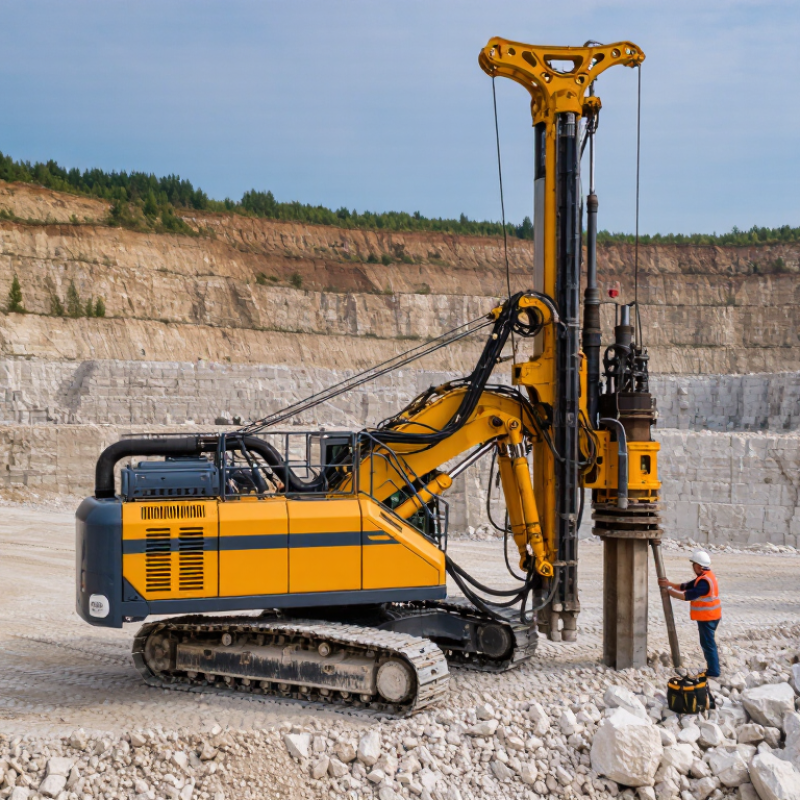
Crawler DTH rigs are a practical choice for quarrying where broken rock demands steady, accurate drilling. Their tracks move across uneven benches without frequent transport equipment. In field work, operators often use them for holes between 100 and 300 meters. The down-the-hole hammer delivers impact energy near the bit, helping maintain penetration in hard formations. Dust control and compressor capacity still matter. A powerful rig alone cannot rescue poor air management.

For quarry managers, hole quality affects blasting results, fragmentation, and wall stability. A crawler platform should offer enough mast reach, feed force, and rod handling capacity for the planned depth. Check the rated depth against actual rock conditions, not brochure figures. Fractured limestone may consume rods faster than expected. Wet seams can also reduce hole cleanliness. Small errors become expensive. Experienced crews inspect drill cuttings, pressure changes, and penetration speed throughout each shift.

Reliable selection begins with a site survey covering rock hardness, bench height, access width, and groundwater conditions. Ask for service records, operator training, and test data from comparable quarries. Fuel use and maintenance access deserve equal attention. I have seen production plans fail because a rig fit the depth but not the turning area. That was an uncomfortable lesson. Local dust, noise, and quarry safety requirements must be verified before mobilization. A short field trial can expose weaknesses that specifications hide.

2026 Top DTH Boring Machine Types for Global Buyers - Crawler DTH Rigs: Best for Quarrying with 100–300 m Drilling Depths

Evaluation Dimension Typical Specification or Range Quarrying Relevance Buyer Consideration
Primary Machine Type Crawler-mounted down-the-hole (DTH) drilling rig Combines tracked mobility with percussion drilling for hard and abrasive formations. Confirm that the rig is designed for surface drilling and compatible with the planned hole diameter.
Recommended Drilling Depth Approximately 100–300 m, depending on rod length, hole diameter, formation, and compressor capacity Suitable for quarry blast holes, geotechnical investigation, water-well work, and selected foundation drilling. Treat depth as an indicative planning range rather than a guaranteed output.
Typical Hole Diameter Approximately 90–305 mm Covers many common quarry blast-hole sizes and medium-diameter exploration holes. Larger diameters generally require higher air delivery, stronger rods, and greater feed force.
Suitable Rock Conditions Medium-hard to very hard, competent rock; commonly used in igneous, metamorphic, and hard sedimentary formations DTH percussion transfers impact energy directly to the bit, supporting effective penetration in hard rock. Highly fractured, soft, or unstable formations may need casing, foam, drilling fluid, or an alternative method.
Drilling Method Compressed-air DTH hammer with a button or cross-bit Provides efficient rock breaking and carries cuttings to the surface through the annulus. Select bit geometry and hammer size according to rock abrasiveness, strength, and hole diameter.
Compressor Air Delivery Often approximately 17–35 m³/min for medium-to-large surface DTH applications Adequate airflow helps power the hammer and remove cuttings from deeper holes. Match free-air delivery and working pressure to the hammer manufacturer’s operating requirements.
Typical Working Pressure Commonly about 1.2–2.5 MPa at the compressor outlet, subject to system losses and hammer design Supports reliable hammer operation in hard-rock quarrying applications. Check pressure at the hammer, not only the compressor, because hose and valve losses reduce available pressure.
Crawler Mobility Steel-track undercarriage with independent or combined track travel control Improves movement across uneven benches, loose aggregate, and rough quarry access roads. Review track width, ground clearance, gradeability, turning radius, and transport dimensions.
Feed System Hydraulic chain, cylinder, or rack-and-pinion feed; commonly configured for multi-rod drilling Provides controlled thrust and rotation during long-hole drilling. Compare feed stroke, maximum pullback force, rod-changing method, and service accessibility.
Drill Rod Configuration Common rod lengths of approximately 3–6 m, assembled progressively to reach the target depth Allows the rig to reach 100–300 m while maintaining manageable handling and transport requirements. Select thread type, rod diameter, straightness tolerance, and replacement availability carefully.
Drilling Angle Usually adjustable from near-vertical to inclined drilling; exact range depends on mast design Supports vertical blast holes and inclined holes used for controlled quarry fragmentation. Confirm angle-locking accuracy, mast rigidity, and stability on sloped benches.
Rotation Speed Often approximately 20–100 rpm, depending on bit diameter, rock type, and hydraulic setup Adjustable rotation helps balance penetration rate, bit wear, and hole straightness. Higher speed is not always better; abrasive rock may require lower speed and controlled torque.
Typical Production Rate Approximately 10–30 m/h in hard rock under favorable operating conditions Can support regular quarry blast-hole production when setup, rod changes, and repositioning are efficient. Actual output varies significantly with rock strength, jointing, hole size, depth, and operator practice.
Power System Diesel-hydraulic power unit is common; electric-hydraulic configurations are also used where grid power is available Diesel power supports remote quarry operation, while electric systems can reduce on-site emissions. Compare engine power, fuel consumption, electrical supply requirements, emissions rules, and maintenance support.
Dust Management Dry dust collection, wet suppression, or a combined dust-control arrangement Helps control respirable silica dust and improves visibility around the drilling area. Verify filter area, collector efficiency, water consumption, maintenance intervals, and local occupational requirements.
Best-Fit Quarry Applications Production blast holes, perimeter holes, secondary breaking, bench development, and selected exploration work Provides a versatile solution for surface mines and aggregate quarries with hard-rock conditions. For very large holes, loose overburden, or highly sensitive vibration zones, compare alternative drilling methods.
Key Advantages Good hard-rock penetration, accurate hole alignment, strong mobility, and scalable depth capability Well suited to repeated drilling cycles across changing quarry benches. Assess total operating cost, including compressor fuel, bits, rods, hammer parts, dust filters, and labor.
Main Limitations High air demand, noise, dust-control requirements, and reduced performance in unstable or water-sensitive formations Operating conditions can strongly affect penetration, hole cleaning, and component life. Complete a formation test and verify local noise, dust, emissions, and site-access requirements before purchase.
Best Buyer Profile Quarry operators, aggregate producers, contractors, mining service companies, and geotechnical drilling teams Provides a balanced option for buyers needing repeated surface drilling at moderate-to-deep depths. Prioritize local parts availability, technician support, operator training, and lifecycle service capability.

Note: The specifications above are indicative industry ranges for crawler-mounted surface DTH rigs. Final performance depends on geology, hole diameter, drilling angle, compressor configuration, tooling, site conditions, and operator skill.

Truck-Mounted DTH Rigs: Mobility, 150–300 mm Holes, and 200 m Reach

Truck-mounted DTH rigs suit global buyers who move between scattered worksites. Their road-ready chassis reduces transport time and setup labor. At a quarry edge, operators can position the mast beside a bench, level the carrier, and begin alignment quickly. That mobility matters when access roads change after rain.

A 150–300 mm hole range covers many water-well, foundation, geothermal, and construction applications. DTH hammers deliver impact at the bit, helping maintain penetration in hard, fractured rock. Yet diameter alone should not guide purchasing. Larger holes demand more air, stronger rods, and careful compressor matching. A 200 m reach is achievable in suitable formations, but depth depends on rock hardness, deviation, rod weight, and flushing efficiency. Test data matters more than brochure optimism.

Buyers should inspect mast stiffness, feed force, dust control, compressor output, and service access. Ask for drilling records from comparable ground. Small details count. A loose connection can stop a shift. Operators also need clear visibility, stable outriggers, and emergency controls. One practical weakness remains: truck-mounted layouts can feel less stable on steep or soft ground. That limitation deserves honest planning, not optimistic assumptions. Choose the rig after reviewing geology, hole tolerance, transport rules, and local maintenance support.

Underground DTH Rigs: Low-Profile Designs for 51–165 mm Mining Holes

Underground DTH rigs for 51–165 mm mining holes must balance compact dimensions with dependable drilling power. Low-profile designs fit narrow headings, shallow stopes, and restricted access tunnels. Their reduced height helps operators work beneath low backs without excessive excavation. In field use, this can save preparation time and reduce ground disturbance.

A suitable rig needs stable feed control, precise rotation, and effective flushing. DTH hammers deliver direct impact energy at the hole bottom, improving penetration through hard rock. However, compressor capacity remains critical. Insufficient air causes slow cleaning, blocked holes, and premature hammer wear. Water injection may control dust, but it can complicate ground conditions and waste management. That choice needs site-specific testing.

MOBILITY Mobility matters underground. Articulated frames, remote controls, and adjustable booms improve positioning around corners and uneven floors. Rod handling systems also reduce manual lifting near the face. Operators should check machine width, turning radius, service access, and emergency isolation features before purchase.

A rig may reach the target diameter but still perform poorly in a cramped heading. I have seen equipment selection focus too heavily on drilling speed. That was a mistake. Fuel use, maintenance access, operator visibility, and spare-part availability often decide real productivity. Buyers should compare trial-hole results, not brochure figures. Depth, rock abrasiveness, deviation, and shift length can change performance significantly. Safety documentation and local operating requirements also deserve careful review.

Global Buyer Comparison: Fuel Use, Penetration Rates, and 2026 ROI Data

For global buyers, DTH boring machine selection starts with ground conditions, not brochure horsepower. Diesel crawler units suit remote hard-rock sites, while electric or hybrid rigs can reduce fuel exposure near stable power. In field comparisons, air consumption often controls operating cost more than drilling speed. A compact rig may burn 12–18 liters per hour, while larger high-pressure systems can exceed 25 liters. These are planning ranges, not guarantees. Rock hardness changes everything.

Penetration rates commonly range from 0.8 to 2.5 meters per minute in competent rock, using suitable bits and pressure. Fractured formations may drill faster, but hole cleaning and casing delays reduce daily output. A practical 2026 ROI model should measure completed meters, fuel cost, bit wear, labor, transport, and downtime. For example, a rig completing 450 productive meters monthly may recover its investment in 18–30 months, depending on contract rates and utilization. That estimate can be optimistic. Weather and spare-part delays are often underestimated.

Tips: Request a seven-day site trial before purchase. Record liters per meter, compressor pressure, penetration rate, and unplanned stops. Compare total cost per completed meter, not machine price alone. Ask for service training and parts availability in your operating region. Keep a 10–15% contingency for consumables and downtime. Small data gaps can distort ROI.